Design System
The behavioral design system behind DuoGit — color tokens, Ghost's emotional states, 60/40 zoning, league progression, and annotated UI components. Every element is wired to a psychological mechanism.
Dark mode only. Primitives feed semantic variables named by role, and components use the semantic ones. A status color always comes with a word or an icon.
Main action
action/primary
#2563EB
On track
status/success
#4ADE80
At risk
status/warning
#FBBF24
Broken, urgent
status/danger
#F87171
Screen background
bg/canvas
#0B1118
Card
bg/surface
#161E2C
Main text
text/primary
#FFFFFF
Secondary text
text/secondary
#94A3B8
Ghost is designed to react to commit activity. Each state maps to a psychological moment in the developer's consistency journey.

Neutral — Ready
Trigger: waiting for the first commit of the day
Day begins. Ghost is calm and expectant — no pressure, pure potential.
Neutral state

Happy — On Track
Trigger: consistent commits over the last 3 days
Positive reinforcement. Ghost celebrates — glowing eyes, energetic posture. The system rewards consistency, not just volume.
Core Drive 2: Accomplishment

Worried — At Risk
Trigger: 20 hours without activity, 4 hours left
Loss aversion activated. Ghost's distress makes the risk visible — empathetic urgency, not punishment.
Core Drive 8: Loss Aversion

Sad — Streak Broken
Trigger: missed yesterday, streak resets
Emotional cost acknowledged — then resilience. Ghost mourns with the developer, then invites a guilt-free restart.
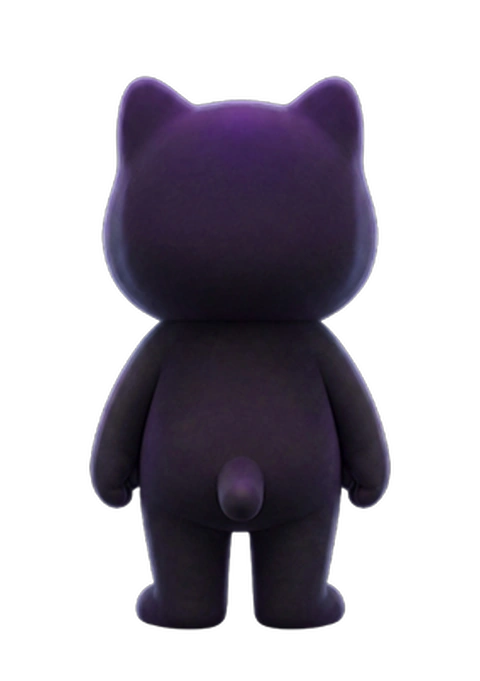
Guilt-free restartSame discipline as Cuak: front, back and gesture range locked before drafting expressions. Ghost's proportions had to hold up from every angle a widget or app screen might crop it to.

Front — neutral
Back view
Gesture range
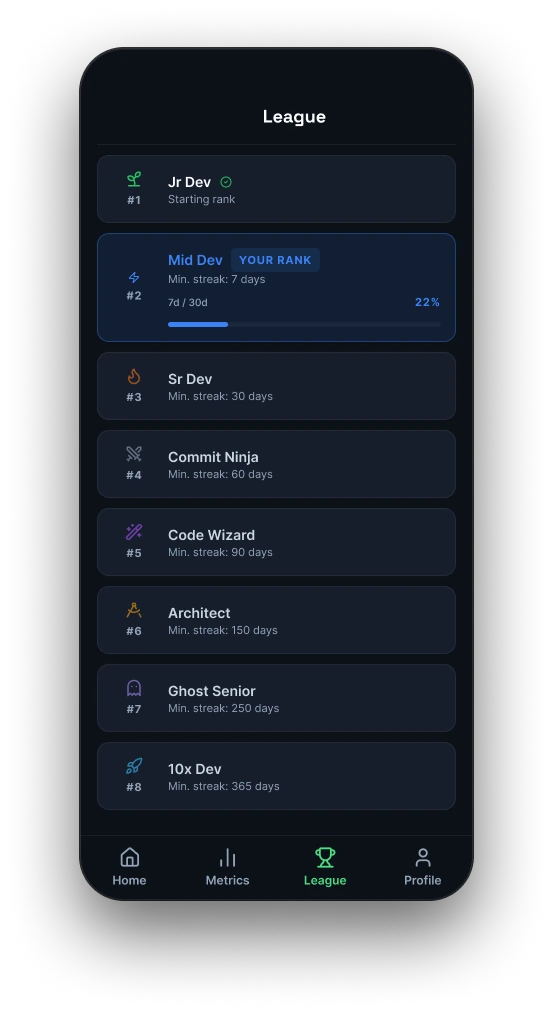
Social influence and status identity (Core Drive 5). The league system gives developers a place to belong — and a reason to keep their streak. Each rank asks for a minimum streak.
Jr Dev
Starting rank
Mid Dev
7 days
Sr Dev
30 days
Commit Ninja
60 days
Code Wizard
90 days
Architect
150 days
Ghost Senior
250 days
10x Dev
365 days
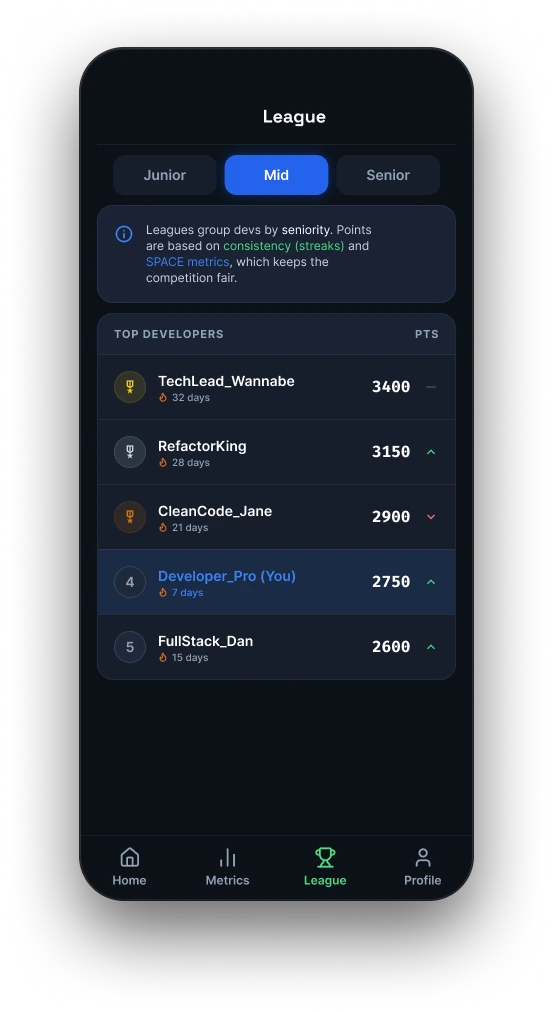
A separate leaderboard compares points, in Junior, Mid and Senior tabs. Points come from streak consistency and SPACE metrics.
League standing — own screen
A full leaderboard, not a badge stapled to the dashboard. "You" is highlighted among peers in the same seniority tab — social identity anchor, Core Drive 5. It's opt-in: developers navigate here, it isn't pushed at them.
Every surface splits 60% commit data / 40% Ghost emotional state. Each zone is mapped to an Octalysis Core Drive.
Small 2×2
Progress Focus
Current streak count + Ghost emotional state. Day-to-day habit engine.
→ Core Drive 2: Accomplishment
Small 2×2
Status Focus
League rank + points. Social identity — who you are in the developer community.
→ Core Drive 5: Social Influence
Wide 4×2 — Risk
Urgency Surface
Time until streak breaks + Worried Ghost. Most powerful retention surface — visible on home screen without opening the app.
→ Core Drive 8: Loss & Avoidance
Same commit data. Completely different emotional experience. DuoGit doesn't change what you did — it changes how it feels.
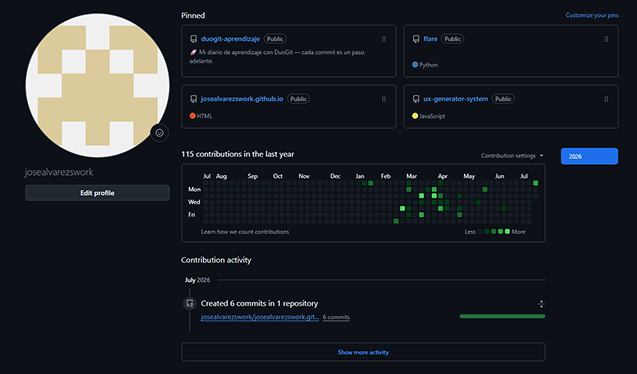
Real activity, zero framing. The graph doesn't say whether this pace is good, whether a streak is at risk, or how it should make you feel — just squares and a count.
Same underlying data — streak framing, Ghost's emotional state, SPACE metrics. Absence feels recoverable, not shameful.
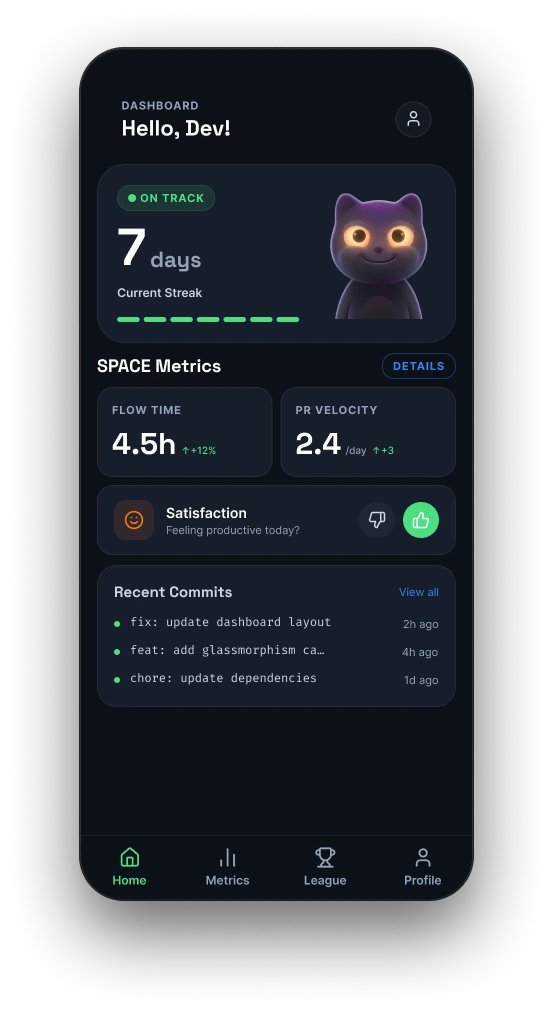
Three dashboard decisions, and the behavioral mechanism each one is built on.
Ghost mascot proxy
Ghost externalizes the developer's relationship with their code activity. Cold commit data becomes a social bond — users feel responsible to Ghost, not just to a number. (Epley & Waytz — Anthropomorphism)
Streak counter — 60% zone
Streak count is the primary behavioral signal. Positioned dominant in the 60% data zone — users see their progress before Ghost's state. Streak = evidence of consistency, not judgment of absence.
Ghost emotional state — 40% zone
Ghost's expression shifts with streak health. Happy = sustain, Worried = act now, Sad = come back. Visceral-level feedback (Don Norman) — no reading required. 40% visual weight keeps it supportive, not dominant.
The Figma file has 13 components: Button, Badge, Chip, Progress, Header, Tab bar, Metric card, Stat row, Feature row, Rank card, Leaderboard row, Commit row and Mood card. Below, redrawn for this page: two of them, plus the streak card and the risk widget, which are not components yet.
Streak card
Current streak
On track
The main retention signal on the dashboard: day count, status word and Ghost's mood read together. The word travels with the color.
Rank card
Mid Dev Your rank
Min. streak: 7 days · 7d / 30d
Where the developer stands and what the next rank asks for. Ranks already passed and ranks still locked use the same card.
Risk widget
Save your streak
03:45:12
Don't break your streak!
Home screen widget with a countdown. Passive loss aversion — visible without opening the app. The most powerful retention touchpoint in the system.
Metric card
Flow time
4.5h ↑ +12%
PR velocity
2.4 /day ↑ +3
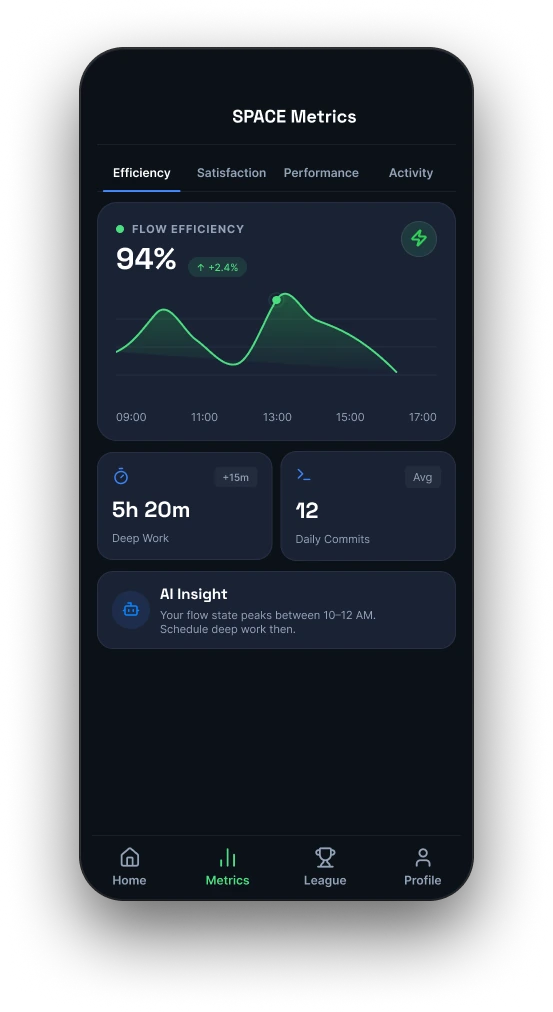
SPACE framework metrics (Satisfaction, Performance, Activity, Communication, Efficiency) — translates GitHub data into developer wellbeing signals, not just productivity numbers.
15 text styles from 10 to 52 px. Space Grotesk for titles, Inter for text, Fira Mono for commits and points.
7 days
Current Streak
Your coding activity directly affects your companion's mood.
Streak history
3400
In November 2026 the nine product screens passed Know your design: 0 errors and 0 warnings, down from 612 and 434. That run left icon colors out. The check now reads them, and the screens do not pass: 31 icon colors on four screens are not bound to the system. Also outside the measurement are 14 shadows without an effect style. Contrast and visual hierarchy are not measured, and the app code does not read these tokens yet.